News

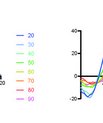
Fig. 1. Fibril formation. A: Thioflavin T (ThT) fluorescence analysis of amyloid formation. B-G: AFM pictures of amyloid formation hIAPP20-29. B: 0h, only tiny oligomers that are approximately 1.4 nm tall are visible. C: 1h, unorganised structures are visible. The striped box is highlighted in order to get a more detailed picture of the structure. D: 1.5h, the structure is more organised and is still growing wider. E-G: 2h, 5h, and 24h, the string begins to twist and grow, cf. transforms into fibrils, however, some of the strings do not transform (highlighted by striped arrows). H: the different structures’ height at different points in time, and the average height for the enterer experiment.

2013.05.08 |

Scientists map type 2 diabetes’ stages of evolution

Many neurodegenerative diseases, e.g. Parkinson, Alzheimer, and Huntington, are caused by the formation of fibrils that is developed from tiny twisted proteins. As a rule one specific protein is connected to one specific disease. However, new research suggests that the formation of fibrils can be associated with other diseases, e.g. type 2…

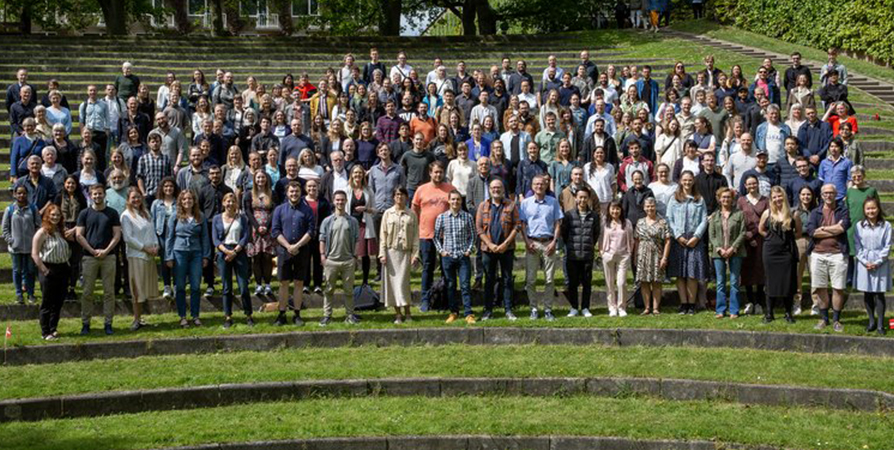
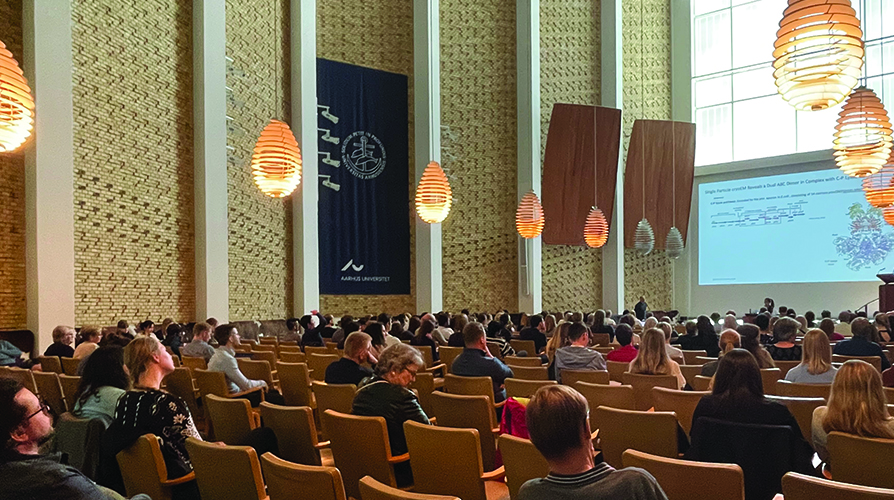
Researchers from many different countries met at Aarhus University to share their experience with neutron protein crystallography. Photo: Poul Nissen
Monika Budayova-Spano from Grenoble, France, is shown addressing the symposium audience about her experience and results. Photo: Ditlev Brodersen

2013.04.05 |

Molecular Biology and Genetics researchers focus attention on billion investment in research

The best and most powerful neutron source in the world – The European Spallation Source (ESS) – will open in Lund, Sweden, in 2019. Denmark is contributing with more than DKK 1 billion to the construction of the new facility. How will basic research in structural biology, biotechnology and medicinal chemistry get the most out of this investment? A…

Torben Heick Jensen has been invited to give a seminar in the prestigious ‘Mendel Lecture series’ in Brno, the Czech Republic. Photo: Lisbeth Heilesen

2013.04.05 |

Torben Heick Jensen speaker at highly esteemed lecture series

Torben Heick Jensen - Professor at the Department of Molecular Biology and Genetics and Director of the Danish National Research Foundation-funded centre for mRNP Biogenesis and Metabolism - has been invited to give a talk in the prestigious ‘Mendel Lecture series’. The event is taking place on 18th April 2013 in Brno, the Czech Republic.

Scientists from Aarhus University have discovered why some species of cereal have higher phytase activity than others and have patented a method for increasing phytase activity in cereal. Photo: Janne Hansen

2013.04.02 |

Phosphorus in wheat can be made more readily available

Scientists from Aarhus University have discovered why some species of cereal have higher phytase activity than others and have patented a method for increasing phytase activity in cereal.

Professor Jens Stougaard is part of an international research team that is involved in developing maize that can create its own fertiliser. On a global scale, this could lead to a reduction in the use of artificial fertilisers and thereby less environmental pollution. Photo: Lisbeth Heilesen
The researchers will now try to get maize to establish symbiosis with bacteria  that can use atmospheric nitrogen, so the plant creates its own fertiliser. Photo: Balaram Mahalder
Dr Stougaard’s research group has already found out how legumes are able to establish symbiosis with bacteria. This knowledge will now be transferred to maize and other cereal crops, so farmers can benefit from this knowledge. Here is the legume Japanese birdsfoot (Lotus japonicus) with nitrogen-fixing root nodules. Photo: Centre for Carbohydrate Recognition and Signalling

2013.03.21 |

Super maize can put sustainable food on the table

A new research project financed by the Bill & Melinda Gates Foundation should pave the way towards a cheap and sustainable solution to some of Africa’s food problems. Researchers at Aarhus University are involved in the efforts to develop maize that can create its own fertiliser. On a global scale, this could lead to a reduction in the use of…

Sodium-potassium pump with binding-pocket for cardiotonic steroids (light blue / red structure). The yellow areas indicate the position of the Na<sup>+</sup>, K<sup>+</sup>-ATPase in which mutations are known to affect the binding of the drug - notice how they clearly enclose the binding pocketFigure: Laure Yatime
The sodium-potassium pump (Na<sup>+</sup>, K<sup>+</sup>-ATPase). Figure: Laure Yatime
First author Laure Yatime carried out the most important part of the research that won the Paper of the Year Award, for which she received a cash prize and a certificate. Photo: Lisbeth Heilesen

2013.03.15 |

Award to the first step towards designing less toxic cardiovascular drugs

New results from Aarhus University show the first, crucial step in dissecting the molecular mechanism behind drugs with an important effect on the heart. The scientific article with these important results was nominated “Paper-of-the-Year” by the international Journal of Structural Biology.

Comments on content: 
Revised 2013.05.17

How to find the Department of Molecular Biology and Genetics

Vis detaljeret kort

Addresses

The Department of Molecular Biology and Genetics (MBG)
is located at four different addresses:

  • The Science Park - Gustav Wieds Vej 10, 8000 Aarhus C
  • Biokæden (Campus) - C.F. Møllers Allé 3, 8000 Aarhus C
  • Foulum - Blichers Allé 20, 8830 Tjele
  • Flakkebjerg - Forsøgsvej 1, 4200 Slagelse

More information on how to find these places and who works where

Contact information

at the Department of Molecular Biology and Genetics


E-mail: mbg@au.dk
Tel.: +45 8715 0000
CVR-no.: 31119103
VAT ("moms") number: 31 11 91 03
EAN-no. 5798000419964
"Stedkode" (departmental id number): 2802

Internal information

MBG news and practical information, teaching, courses, etc.

for staff and students at

the Department of Molecular Biology and Genetics

Aarhus University
Nordre Ringgade 1
DK-8000 Aarhus C

Email: au@au.dk
Tel: +45 8715 0000
Fax: +45 8715 0201

CVR no: 31119103

AU on social media
Facebook
LinkedIn
Twitter
Vimeo