
New breakthrough in RNA research could reshape our understanding of the brain
New research challenges the classical understanding of how genes control brain function. It is not only the proteins that neurons produce that are crucial - but also the RNA instructions that determine where and when these proteins are made.
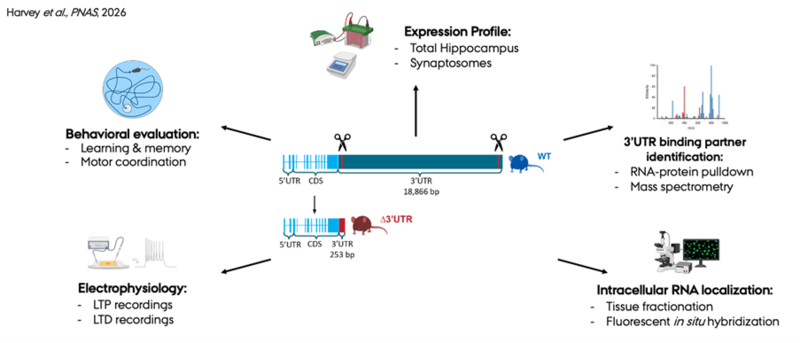
Researchers from the Department of Molecular Biology and Genetics have investigated the gene Grin2b, which plays a central role in brain signalling. The gene contains an unusually long non-coding region, known as the 3’UTR, whose function has until now been unclear. Although this region does not code for protein itself, the study shows that it is crucial for brain function.
A hidden regulator in the brain
The researchers developed a mouse model in which the 3’UTR part of Grin2b was removed, while the protein-coding sequence was left intact. The results were striking: the amount of mRNA remained unchanged, but the level of the corresponding protein, GluN2B, was reduced by half.
At the same time, the protein was significantly reduced in synapses - the contact points where neurons communicate. The mice showed clear signs of impaired synaptic signalling, lost the ability to form long-term potentiation (LTP), and performed worse in tests of spatial learning and memory.
“This study shows that parts of our genes that are usually overlooked actually play a crucial role in how brain cells function,” the researchers explain.
RNA as the cell’s “GPS”
The explanation lies in how mRNA functions in neurons. Although the 3’UTR does not become protein, it acts as a kind of “address code” or GPS that ensures mRNA is transported to the correct locations within the cell - particularly to synapses.
Here, proteins can be produced locally, precisely where they are needed to strengthen or weaken connections between neurons. When this regulation is lost, protein synthesis occurs in the wrong place, weakening brain signalling.
More than just genes and proteins
The study highlights that gene function is not solely determined by protein-coding regions. The non-coding 3’UTR plays a central role in regulating how and where proteins are produced.
This discovery may be key to understanding a range of neurological and psychiatric disorders. GRIN2B has previously been linked to conditions such as autism, epilepsy, intellectual disability, and schizophrenia.
New opportunities for treatment
The findings open a new direction in medical research. Rather than focusing only on proteins, researchers can now turn their attention to RNA and its regulatory role.
In the long term, this may lead to new treatment strategies aimed at restoring proper mRNA localisation or local protein synthesis in the brain. Such RNA-based therapies could potentially improve synaptic function without altering the gene itself.
A new layer of gene regulation
Overall, the study reveals a previously overlooked layer of gene regulation in the brain. While research has traditionally focused on genes and proteins, this work shows that RNA plays a far more active role than previously assumed.
This not only changes our understanding of the brain - but also how we may study and treat brain disorders in the future.
About the research
Type of study: Basic, preclinical neuroscience research
Collaborators:
International: Bevan Scott Main, Georgetown University
AU: Ulrik Bølcho, Anders Nykjær, Mai Marie Holm
Funding:
Novo Nordisk Foundation (0101095)
Danish National Research Foundation (DNRF133)
Competing interests:
The authors report no competing interests
Scientific article:
https://www.pnas.org/doi/10.1073/pnas.2518282123
Contact:
Associate Professor Magnus Kjærgaard
Department of Molecular Biology and Genetics
magnus@mbg.au.dk