
Aarhus researchers receive multi-million funding to map proteins in real time
With a new grant from the Novo Nordisk Foundation, researchers at Aarhus University will, for the first time, be able to follow protein kinases in real time creating “molecular movies” that could transform our understanding of key biological processes.

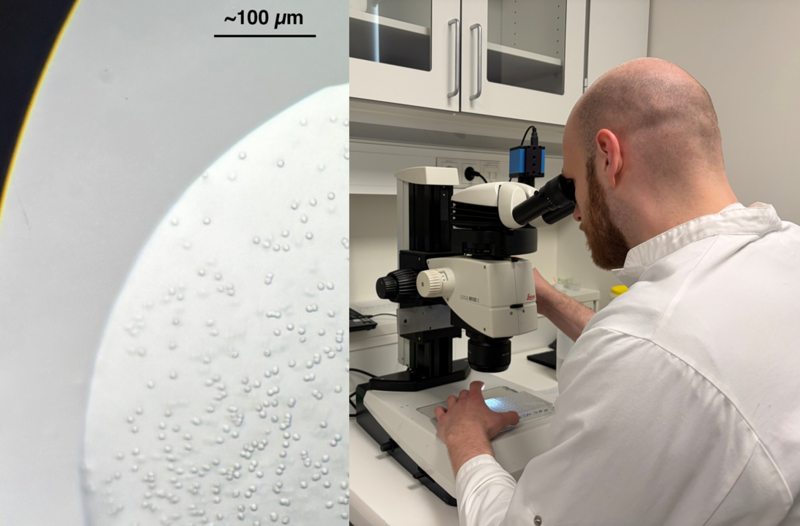
A new research initiative at the Department of Molecular Biology, Aarhus University, led by Ass. Prof. Max T.B. Clabbers, Prof. Kasper R. Andersen, and Prof. Ditlev E. Brodersen, have been awarded 7 million DKK by the Novo Nordisk Foundation to push the boundaries of how we understand some of life’s most important molecular switches.
The project will pioneer the use of so-called time-resolved crystallography to observe protein kinases, which are key regulators of biological processes, in action, effectively creating "molecular movies" of how they work.
The grant, funded through the NNF MicroMAX Collaborative Research programme, brings together a diverse group of experts in structural biology, plant science, and electron diffraction, with the aim of building a critical mass for future research in the area.
Watching biology as it happens
Proteins are often described as the machinery of life, but most structural studies capture them as static snapshots.
In reality, proteins are dynamic says Ditlev Brodersen:
“Proteins move, change shape, and interact with other molecules in tightly coordinated sequences. This is especially true for protein kinases. These enzymes act as molecular switches, turning cellular processes on and off by attaching small chemical tags in the form of phosphate groups to other proteins.”
Proteins play essential roles across all forms of life, from bacteria to plants and animals, and are critical for human health. However, despite decades of research, scientists still lack a detailed understanding of how kinases perform these tasks step by step.
“That’s because we’ve mostly been looking at still images,” explains Ditlev Brodersen, “What we really need is a movie.”
A new generation of structural biology
The new project aims to provide exactly that. Using advanced X-ray diffraction techniques at the MAX IV Laboratory in Lund, Sweden, home to the cutting-edge MicroMAX synchrotron beamline also funded by the Novo Nordisk Foundation, researchers will track structural changes in proteins as they happen in real time.
Instead of analysing a single, large crystal, time-resolved methods rely on thousands of tiny crystals and extremely fast measurements. By initiating a reaction, such as adding the molecule ATP that fuels kinase activity, and capturing data at precise time points, scientists can reconstruct a sequence of structural changes.
The result is a time-resolved view of protein function: A molecular movie rather than a single frame. To make the picture even richer, the team will combine X-ray data with electron-based diffraction. This complementary approach allows them not only to see how proteins move, but also to detect subtle changes in electrical charge, which are critical for understanding how chemical reactions take place.
From plant symbiosis to bacterial defence
The research will focus on two biological systems that illustrate the broad importance of kinases. One involves plants forming beneficial partnerships with nitrogen-fixing bacteria, an interaction essential for sustainable agriculture. Understanding how kinases regulate this process could help improve crop efficiency and reduce reliance on fertilisers.
The other focuses on bacterial defence mechanisms against viruses, also known as bacteriophages. Here, certain kinases appear to play a role in shutting down cellular processes to prevent viral takeover. Insights into this system could deepen our understanding of microbial ecosystems and antiviral strategies aimed at improving our response to human infectious diseases.
Although very different, both systems rely on the same fundamental principle: Precise control through phosphorylation, the chemical modification carried out by kinases.
Building a Danish hub for time-resolved studies
Beyond the scientific discoveries themselves, the project has a broader ambition: To establish Aarhus University as a leading centre for time-resolved structural biology.
The funding will support a team of young researchers, including postdoctoral fellows and a PhD student, working across multiple laboratories. The initiative builds on existing research infrastructure at AU, including crystallization facilities at MBG and advanced cryo-EM capabilities at EMBION, forming a strong technological foundation for time-resolved experiments with both X-rays and electrons.
By integrating expertise in x-ray and electron crystallography, as well as and computational analysis, the project aims to create a critical mass of researchers skilled in these advanced techniques. Importantly, the work will also help develop methods and workflows that other scientists can adopt in the future, lowering the barrier to using time-resolved approaches.
With the new 7 m DKK grant, the research groups involved are set to play a central role in this transformation, advancing both fundamental science and the technologies that make it possible. The project’s outcomes are expected to provide new insights into essential biological processes while training the next generation of scientists in one of the most exciting frontiers of modern biology.
Contact:
Professor Ditlev Egeskov Brodersen
deb@mbg.au.dk