
Can saliva replace blood tests? MBG technology is at the core of a new international malaria project
A new international research initiative is taking its first steps toward developing a saliva-based rapid test for malaria – and the key detection technology behind it originates from the Department of Molecular Biology and Genetics (MBG).
![[Translate to English:]](/fileadmin/_processed_/9/8/csm_20251202_133853_edited_c08ecc8e6a.jpg "[Translate to English:]")
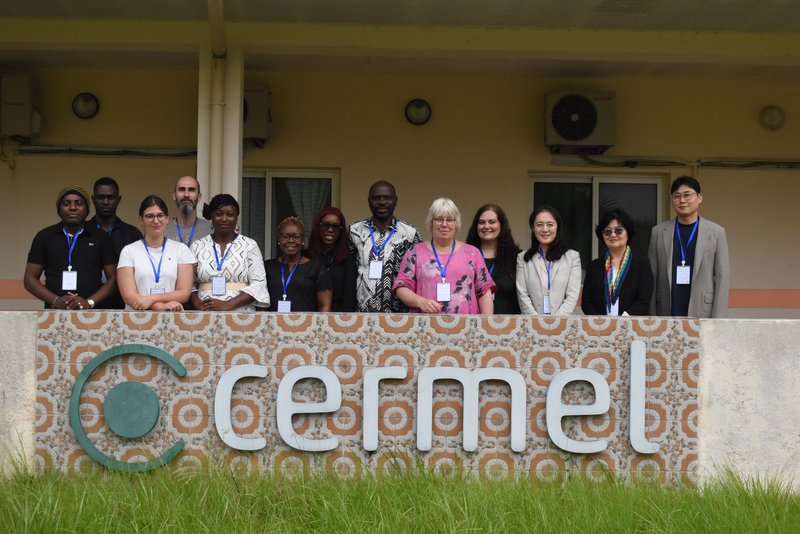
Last week, partners from five countries in three continents gathered at CERMEL in Lambaréné, Gabon, for the official launch meeting of PROMISE, a three-year project funded by the South Korean RIGHT Foundation. The goal is ambitious: to create an accurate, needle-free malaria diagnostic hometest based on saliva specimen that could dramatically improve malaria detection in regions where blood sampling is challenging.
MBG innovation as the foundation
The molecular technology driving the test was developed in Associate Professor Birgitta Knudsen’s group at MBG. Originally designed as a highly sensitive detection platform for specific enzyme detection. Using an essential enzyme specific to the malaria parasite, Plasmodium spp., the system can identify malaria parasites at extremely low concentrations. Over the past years, the technology has been further refined in collaboration with VPCIR bioscience, an MBG spin-out company specializing in diagnostic innovation.
“This project shows how fundamental molecular research can lead to practical solutions with global impact,” says Birgitta Knudsen. “A saliva-based test could make malaria diagnostics more accessible, especially for children and communities where blood sampling is difficult or culturally sensitive.”
The MBG team behind the project
Several key members of the MBG team are directly involved in developing the new saliva-based malaria test. Laboratory technician Noriko Hansen provides technical assistance, prepares essential reagents, and contributes to laboratory testing during protocol optimisation. Birgitta Knudsen (PhD, Associate Professor) is co-inventor of the MBG-developed technology and serves as PI and Work Package leader for MBG’s activities in PROMISE. Florian Noulin (PhD, Postdoctoral Researcher) brings 20 years of experience in malaria research, including extensive fieldwork in Africa, and plays a central role in developing and validating protocols at CERMEL in Gabon. Cinzia Tesauro (PhD, Assistant Professor), also a co-inventor of the technology, works closely on protocol optimisation and development.
Broad international collaboration
PROMISE is coordinated by the Bernhard Nocht Institute for Tropical Medicine (BNITM) in Hamburg and brings together partners from Gabon, Germany, Denmark, Switzerland, South Korea. Clinical testing is already underway at CERMEL in Gabon, with wider field studies planned for additional malaria-endemic regions such as Benin.
For MBG and its partners, the project represents a rare opportunity: to transform a Danish laboratory discovery into a practical, low-cost diagnostic tool with the potential to benefit millions.
Official press release from PROMISE:
Spitting instead of pricking: International research project PROMISE aims to revolutionise malaria diagnosis
Malaria tests based on saliva samples instead of blood samples – that is the vision of a transnational research consortium that is meeting for the first time today in Gabon. Under the leadership of the Bernhard Nocht Institute for Tropical Medicine (BNITM), the researchers want to launch a novel saliva test that is hygienic, painless and potentially usable anywhere. The project is being funded with around 2.5 million euros by the South Korean RIGHT Foundation. It will run for three years.
Malaria remains one of the most dangerous infectious diseases. According to estimates by the World Health Organization (WHO), around 263 million people fell ill in 2023 alone, and almost 620,000 died; most of them were children under the age of five in Africa. Four countries, including Nigeria and the Democratic Republic of Congo, account for half of the global disease burden.
Why many people do not get tested
Although early diagnosis can save lives, many people shy away from going to the testing station. Blood sampling is unpleasant, especially for children, and is sometimes taboo or simply not possible when the availability of medical staff is limited. In addition, even the latest rapid blood-based tests do not always provide reliable results, for example in the case of rarer malaria pathogens or genetic variants of the parasite. PROMISE aims to address this issue with a test that does not require a needle but is highly accurate.
Malaria has traditionally been diagnosed by detecting pathogen components in the blood. The new diagnostic system relies on saliva. The central biomarker is an enzyme produced by the malaria pathogen that can be reliably detected even at low parasite loads – with high specificity and sensitivity. The test format is based on a lateral flow assay (LFA), a rapid paper strip test similar to a pregnancy test.
From laboratory device to practical rapid test
The technology was developed by the Department of Molecular Biology and Genetics (AUMBG) at Aarhus University in Denmark and is now transferred to market. Implementation involves several steps: optimising the enzyme detection technology, developing an easy-to-use saliva sampling system and producing stable, storable test reagents. The test will be clinically tested in several countries, including Gabon, Benin and South Korea. In the future, it will also be used in other malaria-endemic areas.
“Our vision is a universally applicable rapid test that works for all age groups and all types of malaria – without the need for blood. This would enable us to revolutionise diagnostics even in remote regions," says Prof. Dr. Ghyslain Mombo-Ngoma, project coordinator and working group leader at BNITM as well as head of drug research at the Centre de Recherches Médicales de Lambaréné (CERMEL) in Gabon.
Enabling access, improving care
The project is funded by the RIGHT Foundation (Research Investment for Global Health Technology) in South Korea with around 2.5 million euros. The research partners are committed to making the future diagnostic product affordable and widely available, especially in countries with a high disease burden.
The aim of the clinical trials is to create the necessary conditions for the approval by the Europe-based authorities in charge and a recommendation by the World Health Organization (WHO). In addition, a laboratory test is planned for research institutions, which will allow the results of the rapid test to be precisely verified and compared for quality assurance purposes. This laboratory test will be available worldwide, also at an affordable cost.
Partner countries: Gabon, Germany, Denmark, Switzerland, South Korea
Partner institutions
· Bernhard Nocht Institute for Tropical Medicine (BNITM), Germany – project coordination
· Aarhus University, Dept. of Molecular Biology and Genetics (AUMBG), Denmark
· Genes Laboratories, Republic of Korea
· GC Laboratories, Republic of Korea
· VPCIR biosciences ApS, Denmark
· Foundation for Innovative New Diagnostics (FIND), Switzerland
· Centre de Recherches Médicales de Lambaréné (CERMEL), Gabon