
Inside the Plant-PATH Lab: Protein Purification in Action
Plant-PATH researchers Assia Khalild (ULB) and Lynette Nel (AU) have successfully purified membrane proteins in Aarhus, paving the way for advanced HDX mass spectrometry analysis in Brussels. Their work highlights the power of cross-institutional collaboration in uncovering how plants adapt to climate change.

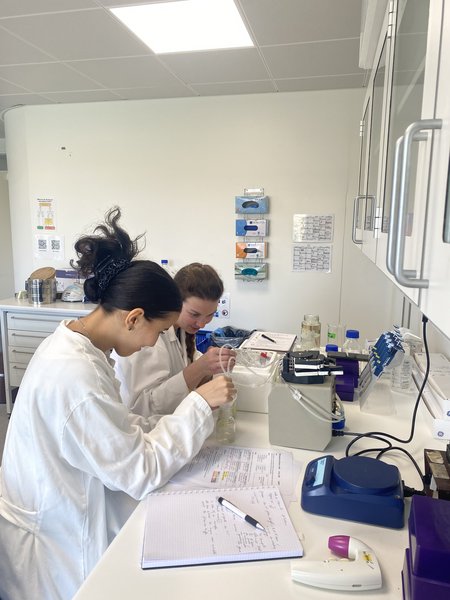
Behind the scenes at the Plant-PATH Center, collaboration is at the heart of discovery. At the Department of Molecular Biology and Genetics, Aarhus University, researchers are working side by side to unravel the molecular processes that enable plants to adapt to changing environments.
Recently, Assia Khalild, visiting from our satellite group at Université libre de Bruxelles (ULB), joined Lynette Nel in the Aarhus lab to carry out the crucial task of purifying membrane proteins. This work is an essential first step before samples are transferred to Brussels for advanced hydrogen–deuterium exchange (HDX) mass spectrometry analysis, a powerful technique that reveals the dynamic behavior of proteins at the molecular level.
Over the course of the protocol, the team successfully completed protein recovery after dialysis, followed by concentration and size exclusion chromatography (SEC). These steps enabled the isolation of the target membrane protein in purified form — a critical milestone in preparing for downstream structural analysis.
The purified protein will now return to Brussels, where it will be studied in the laboratory of Chloé Martens, our Plant-PATH group leader in Belgium, using HDX mass spectrometry. By examining how proteins move and shift in response to their environment, this research provides new insights into how plants respond and adapt to climate change.
This collaborative effort between Aarhus University and ULB exemplifies the value of cross-institutional partnerships in structural and molecular plant biology.