
Thank you all for the interest in the Dynamics and Regulation of Plant Transport Hormones conference
Thank you to everyone who joined us for the "Dynamics and Regulation of Plant Transport Hormones" conference. Held at the Technische Universität Mûnchen (TUM) in Freising, Plant-PATH co-organised this two-day meeting together with the TUM Institute for Advanced Study (IAS).

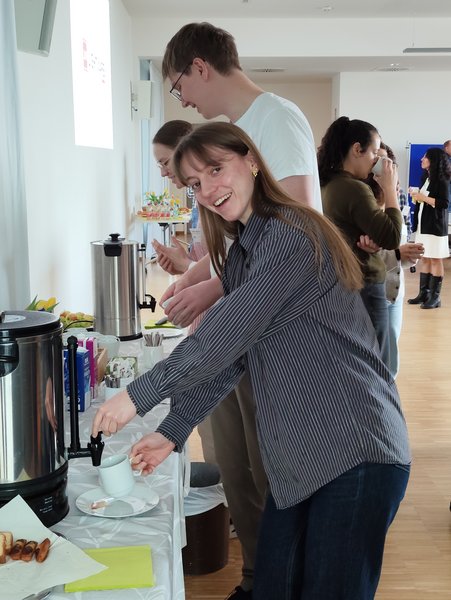
For the conference, we explored everything from high-impact insights into transporter mechanisms and membrane dynamics to discussions on hormone signalling, plant physiology, and modelling. Just some of the highlights included inspiring contributions from all our Plant-PATH Center group leaders, but also from external key-talkers: Prof. Dr. Claus Schwechheimer (Technische Universität München) on AGC1 kinases and the power of movement in plants, Prof. Yunde Zhao (University of California San Diego) on auxin-mediated flower initiation, and Prof. Dr. Dietmar Geiger (Julius-Maximilians-Universität Würzburg) on how plant bitter compounds affect honeybee sugar perception - to name just a few of the diverse subjects covered at the conference.
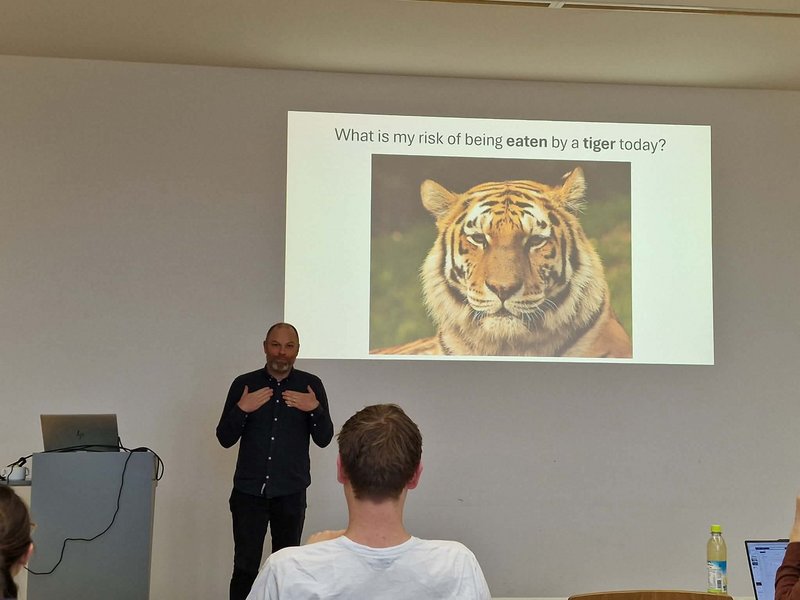
The programme truly reflected the breadth, depth, and good humour of our field (including a discussion about the hypothetical risk of one of our centre leaders, Magnus, falling victim to a tiger attack… if you’re sceptical, the photo provides proof!).
What made the conference memorable was the diversity of perspectives and experience in the room: presentations were made by both established leaders in their respective fields to emerging early-career Plant-PATH researchers, such as Assia Khalild, Bjørn Lildal Amsinck, Sarah Koutnik-Abele, and Lukas Schulz.
We are deeply grateful to Technische Universität München for hosting us so generously, and for the wonderful hospitality, including dinner and beers at the world’s oldest brewery, the historic Bräustüberl Weihenstephan.
Here’s to continued collaboration and pushing the boundaries of plant hormone transport research together.
Finally, thanks as always to The Danish National Research Foundation, whose support helps our center to co-organise and take part in initiatives such as these.