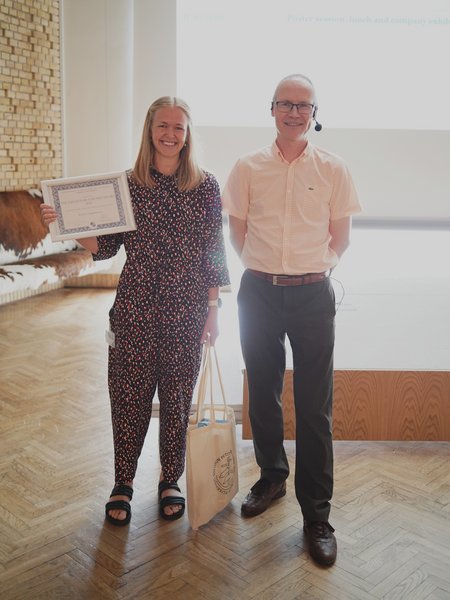
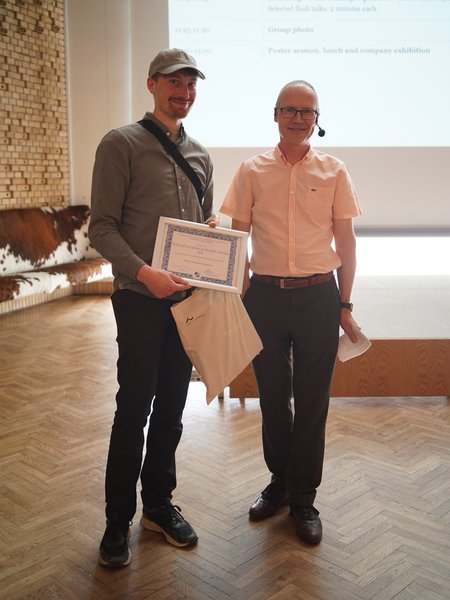
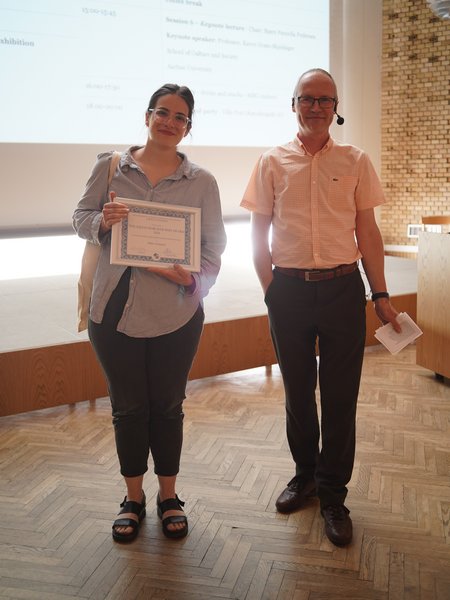
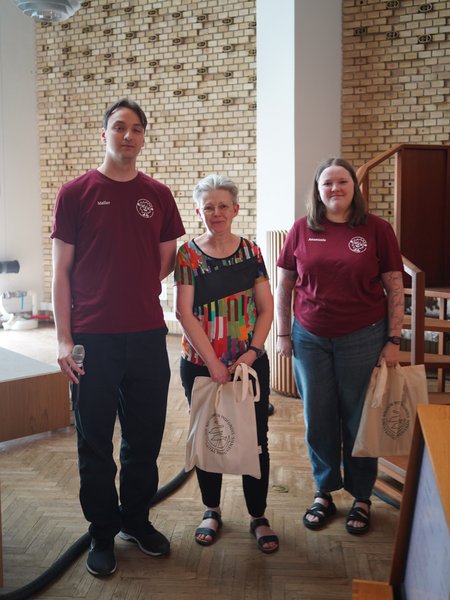
The MBG PhD program committee has in 2019 established an MBG PhD prize which is named in honor of Kjeld Marcker, one of the founding professors of our Department.
The price is given to exceptional PhD students who have defended their PhD study in the last year. There is no fixed number of prices per year, but only truly outstanding candidates will be considered.
The VIP members of the PhD program committee assess the nominated candidates on their overall performance. All activities during the PhD study are considered, but scientific success will be weighted strongly. Obvious aspects are publications, independence and initiative in the scientific work, popular science activities, but also any other activities within the Department or University.
Self-nomination is not possible, but anyone, including PhD students, is welcome to suggest candidates to the MBG program committee.
Kathrine Tejlgård Jensen published no less than 7 papers during her PhD, with two additional papers pending. She is also the major inventor on a patent application. The work involved characterisation of specific protein inhibitors that affect cancer prognosis by binding to plasma proteases, ultimately resulting in several crystal structures. During the stay abroad at KTH in Stockholm, which was partly funded by a grant the she acquired herself, Kathrine Tejlgård Jensen learned phage display and discovered a small nanobody that could be used to block the inhibitor and realised that this could have translational value and commercial potential. The applicant also gave birth to two children during her PhD showing a great example of how to combine work life and private life.
Martin Jørgensen collaborated with Kathrine during his PhD but specialised in cryo-electron microscopy, both at AU and during the stay abroad in Milan. During the project, the he determined multiple structures of conformational intermediates of proteins involved in human innate immunity resulting in a first-author paper in Nature Structural and Molecular Biology and another under review in Nature Communications. In addition, he co-authored four other published papers. Due to his mastery of methods in structural biology, Martin Jørgensen has been a dedicated teacher and beloved instructor over several years. He has also been active outside the research area, volunteering in the AU PhD association and co-founding the greenMBG initiative to reduce waste and save the environment. Finally, he is well known to have been the only person from the department ever who took the train back and forth to a conference on the Greek island of Spetses.
Malita Nørgaard focused on establishing how plants communicate with symbiotic nitrogen-fixing bacteria. During the PhD project, she identified a key phosphorylation event that triggers receptor activation and downstream organogenesis of the root nodule structure. This seminal finding was published in PNAS in 2024 with the awardee as co-first author. Subsequently, she continued to build on this work and went on to unravel how the receptor activation connects to cytoplasmic signaling and transcriptional reprogramming in the plant. She is described at the same time as very rigorous and very creative, which is a perfect mix for a scientist. To younger students, she has served as a role model for the collaborative atmosphere in the lab and is described as an enthusiastic speaker.
Alex Harvey exemplified molecular neuroscience at its best with work spanning from animal behaviour to molecular structure. The PhD project involved both development of a knock-out mouse model and electrophysiology and resulted in a first author paper in PNAS. Not only did Alex Harvey have to implement most of the methods used independently as they were not previously established in the labs, he also had to change supervisor along the way. Aside from the science, he spear-headed the development of lab code-of-conduct and the establishment of an onboarding coordinator in the Magnus Kjærgaard lab. The prize was recieved by Magnus Kjærgaards group.